
The landscape of Indian higher education is undergoing a seismic shift. Driven by the National Education Policy (NEP) 2020, the University Grants Commission (UGC) has rolled out a series of transformative rules for the 2024-2025 academic sessions and beyond.
Whether you are a student, a PhD aspirant, or an academic professional, these changes are designed to make education more flexible, global, and skill-oriented.
Here is a detailed breakdown of the new UGC rules you need to know.
1. The "Student-First" Undergraduate Reforms
The most visible changes are happening at the undergraduate level, moving away from rigid 3-year degrees to a flexible, credit-based system.
Four-Year Undergraduate Programme (FYUP)
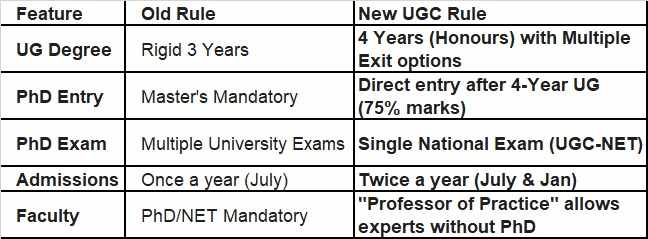
Structure: The standard degree is now shifting to a 4-year Honours format.
Multiple Entry & Exit Options: This is a game-changer for students who may need to take a break.
Exit after Year 1: Certificate.
Exit after Year 2: Diploma.
Exit after Year 3: Bachelor’s Degree.
Completion of Year 4: Bachelor’s Degree with Honours (or Honours with Research).
Direct PhD Access: Students completing the 4-year degree with a minimum CGPA of 7.5 are now eligible to apply directly for PhD programs, skipping the Master’s degree requirement.
Biannual Admissions
Universities can now offer admissions twice a year (July-August and January-February). This mirrors the global university standard, allowing students who missed the summer intake to apply in winter without waiting a full year.
Mandatory Internships
Theory is no longer enough. The UGC has mandated 60-120 hours of internships for undergraduate students.
Credits: Internships now carry 2–4 academic credits.
Scope: These can be with industries, NGOs, or research labs.
Research Internships: 4th-year students must undertake a research internship to build analytical skills.
2. Major Changes for PhD Aspirants
The path to a doctorate has been streamlined to reduce the burden of multiple entrance exams.
NET Score is Now the Single Gateway
Starting from the 2024-25 session, UGC-NET scores are mandatory for PhD admissions. Universities will no longer conduct separate entrance exams for NET-qualified candidates.
Category 1: Eligible for JRF (Junior Research Fellowship) + Assistant Professor + PhD Admission.
Category 2: Eligible for Assistant Professor + PhD Admission (no JRF).
Category 3: Eligible for PhD Admission Only.
Note: For Category 2 and 3, the NET score carries 70% weightage, and the interview carries 30% weightage.
Part-Time PhD for Professionals
To encourage industry-academia linkage, the UGC now allows working professionals to pursue a part-time PhD.
Requirement: You must have a "No Objection Certificate" (NOC) from your employer.
Coursework: The 6-month coursework is still mandatory but can be completed in a modular or flexible manner.
3. Global Integration: Foreign Universities in India
The UGC is tearing down borders to bring world-class education to India.
Foreign University Campuses: Top-ranked foreign universities are now permitted to set up physical campuses in India. They can grant degrees that are equivalent to their parent institution's degrees.
Dual & Joint Degrees: Indian universities can collaborate with foreign institutions to offer:
Twinning Programs: Part of the course in India, part abroad.
Joint Degrees: Curriculum designed jointly by both institutions.
Dual Degrees: Two separate degrees awarded for the same stream by both partner universities.
Foreign Degree Equivalence: A new framework (2025) simplifies the recognition of degrees obtained from foreign universities, ensuring students returning to India face fewer bureaucratic hurdles.
4. Faculty & Recruitment: The "Professor of Practice"
The UGC wants industry experts in the classroom, even if they don't have traditional academic degrees.
Professor of Practice (PoP): Experts with 15+ years of experience in fields like engineering, media, arts, or civil services can be hired as faculty members.
No PhD Required: For PoP positions, a PhD or NET qualification is not mandatory.
Tenure: These appointments are fixed-term (up to 3 years, extendable by 1 year), ensuring a fresh flow of industry trends into the curriculum.
5. The Digital Backbone: Academic Bank of Credits (ABC)
Think of this as a "bank account" for your studies.
How it works: Every student gets a unique ABC ID. Every time you pass a course, credits are deposited into your digital account.
Benefit: If you transfer colleges or drop out and return later, your "banked" credits are redeemed. You don't have to repeat the first year or second year if you have the credits stored.
What This Means For You
If you are a student: You have more freedom. You can design your own degree, mix subjects (e.g., Physics with Music), and learn at your own pace.
If you are a working professional: You can return to academia as a Professor of Practice or pursue a part-time PhD without quitting your job.
If you are a university: You must upgrade your infrastructure to handle the Academic Bank of Credits and establish industry cells for mandatory internships.


















Write a comment ...