
We make promises and agreements constantly in our daily lives, from simple arrangements with friends to more formal business deals. We agree to meet for coffee, promise to pay back a small loan, or sign up for a new service. But what's the real difference between a casual promise and an ironclad contract in the eyes of the law? The answer is more specific—and more interesting—than you might think.
1. A Promise Isn't a Contract (Unless You Intend It To Be)
A simple promise or a social agreement doesn't automatically become a contract. The most critical difference is the intention to create a legal relationship. The law's first question is whether the parties involved actually intended for their agreement to have legal consequences. If there was no intention to be legally bound, a court won't enforce the promise.
Social Agreement (Not a Contract): Imagine a father promises his son ₹500 in pocket allowance every month. If he later refuses to pay, the son cannot take him to court. This is a domestic arrangement where there was no intent to create a legally enforceable relationship.
Business Agreement (Is a Contract): Now consider a scenario where person A sells goods to person B on the condition that payment is made within 30 days. This is a commercial transaction where both parties clearly intend to create a legal relationship. If B fails to pay, A has the right to sue.
This distinction is crucial for judicial efficiency and personal freedom. Courts would be overwhelmed if they had to enforce every family promise, and the law respects that not all agreements are meant to be legally binding shackles. It focuses its power on commerce, where parties explicitly rely on legal enforceability to conduct business.
2. The Two-Part Recipe for Every Legal Contract
To be valid, any contract must satisfy a fundamental formula. Understanding this recipe is key to seeing how a simple agreement transforms into a legally binding obligation. The two-part structure is: Contract = Agreement + Enforceability by law.
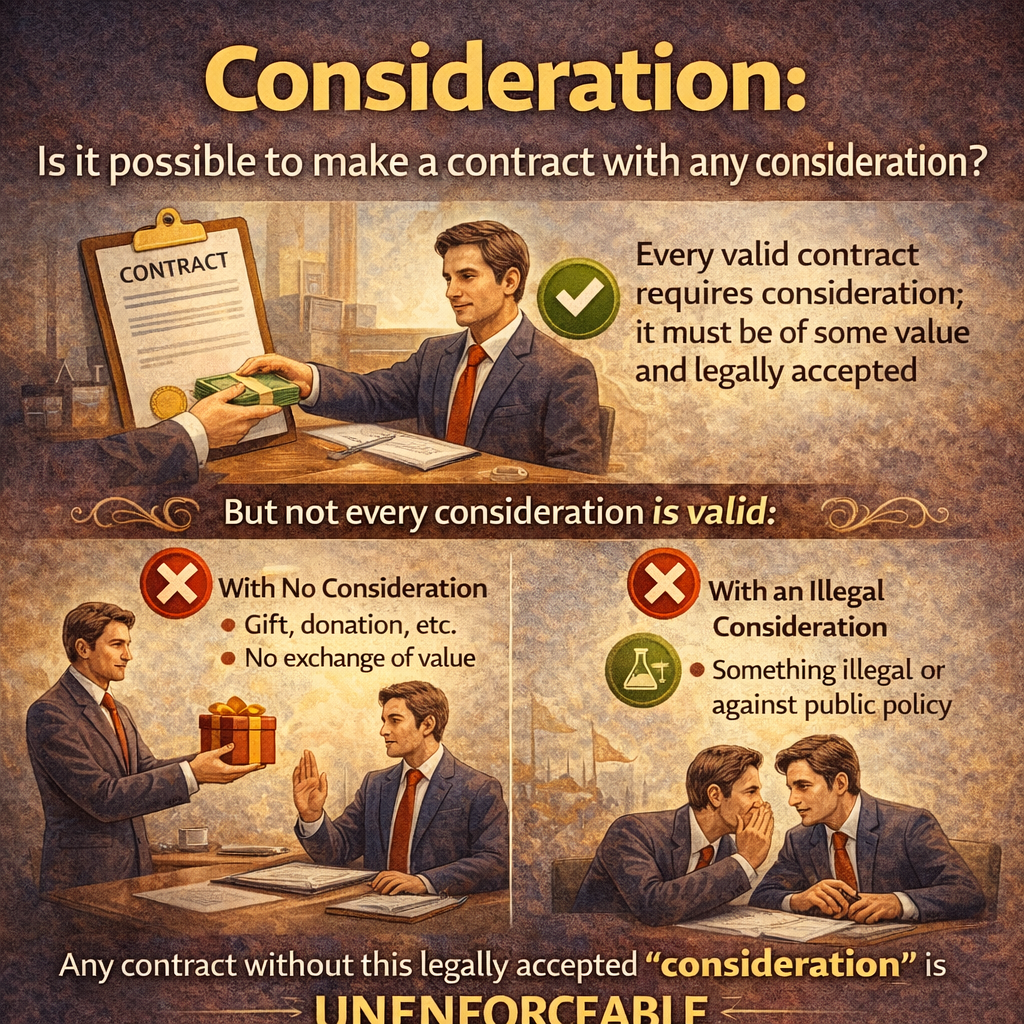
An Agreement is the foundation, and it is formed when one party makes an offer, the other party accepts it, and there is consideration. The formula is Agreement = Offer/Proposal + Acceptance + Consideration. Consideration is the legal term for ‘quid pro quo’ or ‘something in return’. It’s the value that each party agrees to give to the other—for example, the money for the books and the books for the money.
Enforceability is the component that gives the agreement legal teeth. It means that if one party breaks their promise, the other party can use the court system to compel them to perform their obligation or pay damages.
The Indian Contract Act, 1872, puts it succinctly:
“an agreement enforceable by law”
Let's apply this to a practical example. A agrees to sell a car to B for ₹2 lacs. The agreement exists because A offered to sell, B accepted the offer, and consideration is present (the car and the money). The enforceability exists because A now has a legal right to receive the ₹2 lacs, and B has a legal right to receive the car. This combination creates a valid contract.
3. Some Contracts Don't Need Words
While we often think of contracts as written documents or verbal promises, many are formed where actions and conduct speak louder than words. These are called Implied Contracts, where the agreement is understood through the behavior of the parties involved without a single word being spoken or written.
Imagine a coolie in uniform at a railway station picks up your luggage. If you allow him to carry it, an implied contract is formed. Your action of allowing him to proceed implies a promise to pay for his service.
An even more common example is a "Tacit Contract," which is a type of implied contract. When you withdraw cash from an ATM, your actions create a contract with the bank based entirely on conduct.
This principle shows how deeply contract law is embedded in our daily commercial activities, often operating silently in the background of routine transactions.
4. A Perfectly Good Contract Can Become Void
A contract can start its life as perfectly valid, containing all the essential elements needed for enforceability. However, subsequent events can render it impossible to perform, turning it into what the law calls a "void" contract. As Section 2(j) of the Act states: "A contract which ceases to be enforceable by law becomes void when it ceases to be enforceable.”
This means that if circumstances change in a way that makes fulfilling the contract impossible, it is no longer legally binding.
Impossibility by Death: Mr. X, an author, signs a valid contract to write a book for a publisher. A few days later, he tragically dies in an accident. The contract becomes void because it is now impossible for him to perform his personal promise.
Impossibility by Destruction: A contracts to supply 10 tons of sugar from a specific factory to B. Before the supply can be made, the factory burns down and all its contents are destroyed. The contract becomes void because the subject matter has been destroyed.
This principle, known as the doctrine of impossibility, shows that contract law is pragmatic. It recognizes that forcing a party to do the impossible is unjust. It provides a legal off-ramp when unforeseen events, entirely beyond the parties' control, fundamentally destroy the basis of the agreement, ensuring that a contract does not become a tool of oppression.
Conclusion
A contract is far more than a simple promise. It is a precise legal instrument built on the clear intention of the parties, a formal agreement (including offer, acceptance, and consideration), and the critical element of legal enforceability. From spoken words to silent actions, and from valid beginnings to void endings, the principles of contract law govern a vast range of our interactions.
Now that you know the building blocks of a contract, how many legally-binding agreements do you think you enter into each week without even realizing it?






![Manusmriti [English / Hindi]](https://sk0.blr1.cdn.digitaloceanspaces.com/sites/66972/posts/1581014/ChatGPT-Image-Jan-11-2026-052933-PM.png)

![Ramayana [Multi Languages]](https://sk0.blr1.cdn.digitaloceanspaces.com/sites/66972/posts/1580625/ChatGPT-Image-Jan-11-2026-030025-PM.png)
![Chanakya Neeti Darpan [चाणक्य नीति दर्पण]](https://sk0.blr1.cdn.digitaloceanspaces.com/sites/66972/posts/1580618/ChatGPT-Image-Jan-11-2026-025628-PM.png)
![Hastrekha Vigyan and Panchanguli Sadhana [हस्तरेखा विज्ञान और पंचांगुली साधना]](https://sk0.blr1.cdn.digitaloceanspaces.com/sites/66972/posts/1580432/ChatGPT-Image-Jan-11-2026-114757-AM.png)

![Ayurveda [Hindi]](https://sk0.blr1.cdn.digitaloceanspaces.com/sites/66972/posts/1580425/ChatGPT-Image-Jan-11-2026-113658-AM.png)
![Ayurveda [English]](https://sk0.blr1.cdn.digitaloceanspaces.com/sites/66972/posts/1580420/ChatGPT-Image-Jan-11-2026-113658-AM.png)
![Geeta [All Languages and Versions]](https://sk0.blr1.cdn.digitaloceanspaces.com/sites/66972/posts/1580166/ChatGPT-Image-Jan-11-2026-100503-AM.png)
![Aatmbodh [आत्मबोध]](https://sk0.blr1.cdn.digitaloceanspaces.com/sites/66972/posts/1580164/ChatGPT-Image-Jan-11-2026-095746-AM.png)



![Bhagwat Geeta Explanation in Hindi [Audio Only]](https://sk0.blr1.cdn.digitaloceanspaces.com/sites/66972/posts/1523215/ChatGPT-Image-Dec-24-2025-075732-PM.png)
Write a comment ...